Beyond Burnout: The Leader’s Guide to stop crisis fatigue
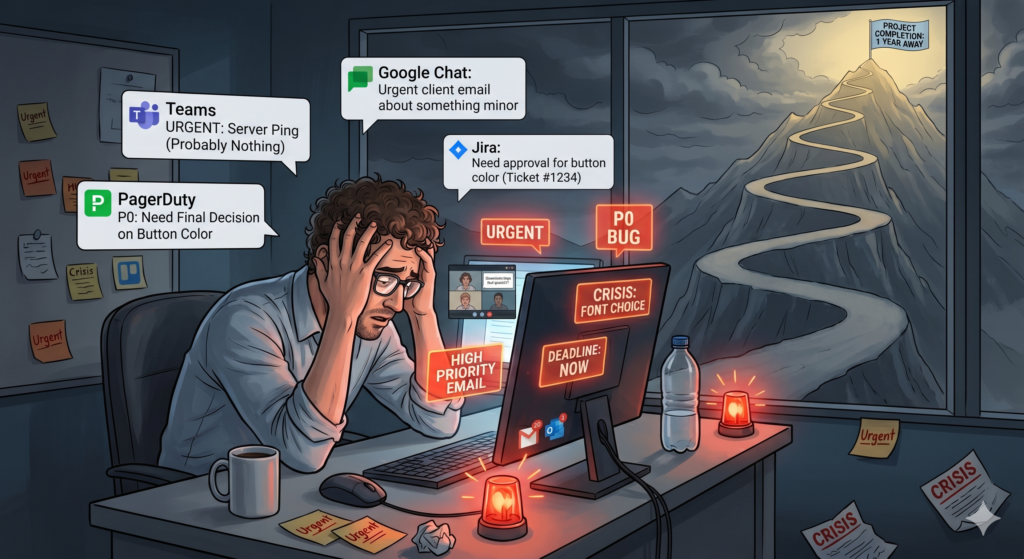
How to Stop ‘Crisis Fatigue’ Before It Kills Your Project
You know that feeling. It’s 4:00 PM on a Tuesday, your Slack notification makes a specific ding the one reserved for the “Urgent” channel. You feel a weird mix of heavy limbs and a brain that’s decided to go on an unannounced vacation to Hawaii. If your first instinct is to close your laptop and pretend you live in a pre-industrial society, you aren’t lazy. You’re likely experiencing crisis fatigue.
In the world of long-term projects, for those projects that span six months, a year or even longer, crisis fatigue is the silent productivity killer. It’s what happens when you’ve spent months treating every minor hiccup like a five-alarm fire. Eventually, the bells keep ringing, but your team has stopped putting on their boots.
So, how do we fix it? How do we keep the momentum going without burning the engine out? Let’s dive in.
What Exactly is Crisis Fatigue?
In short: It’s burnout’s annoying younger sibling who won’t stop poking you.
Biologically, our bodies are built for short bursts of stress. Back in the day, if a tiger chased you, your brain dumped adrenaline and cortisol into your system, you ran away and then you napped for three days. It was a clear cycle:
Stress -> Action -> Resolution -> Rest.
Long-term projects break this cycle. They often feel like a tiger chasing you for eighteen consecutive months. When everything is a high-priority crisis, your brain stays in a permanent state of high alert. Eventually, the surge capacity, the mental and emotional battery we use to survive high-stress situations runs dry.
When your team hits this point, you’ll notice:
Apathy: “Oh, the server is down again? Cool. I’m going to finish my coffee.”
Decision Paralysis: Simple choices feel like life-or-death situations.
Cynicism: The project’s mission starts to feel like a joke.
Friction: Teammates start snapping at each other over things as small as a misplaced comma.
Strategy 1: Stop Crying Wolf
The biggest contributor to crisis fatigue is artificial urgency. If every email is marked “High Priority” and every bug is a P0, then nothing is actually a priority.
To manage fatigue, you have to audit your language. As a leader or even a senior contributor, you need to be the gatekeeper of what constitutes a real crisis.
Define the Tiers. Explicitly define what a crisis is. If it’s not affecting the core product or costing the company per hour, it’s a challenge, not a crisis. Also, before tagging someone at 8:00 PM, ask yourself Will the project collapse if this waits until 9:00 AM? 99% of the time, the answer is no.
Strategy 2: Modularize the Mountain
Long-term projects are exhausting because the finish line is so far away you can’t even see it with binoculars. This leads to a feeling of forever-ness that breeds fatigue. The Fix is to break the project into neighborhoods. Instead of focusing on the 12-month launch date, focus on 4-week mini-missions. Treat each mini-mission as its own entity with its own beginning, middle and most importantly celebrated end.
When you finish a neighborhood, stop. Don’t immediately jump into the next one on Monday morning. Take Monday as a low-stakes day where folks can clear their inboxes or catch up on professional development. Let’s celebrate, we have accomplished a milestone. Or let’s plan to deliver on Wednesday instead of Friday. Any overflow can be managed on Thursday and celebrate this weekend, the team has achieved a mini mission. Let’s add some fun and enjoy the project. You need to signal to the brain that a phase has ended so the stress cycle can close and the energy is renewed.
Strategy 3: The After-Action Reflection
When a genuine crisis happens in a long-term project like a major technical failure or a sudden shift in market requirements the instinct is to fix it and immediately move on to the next task.
This is a mistake. This builds layers of unresolved stress.
Instead, implement post-crisis decompressions. These aren’t just post-mortems where you look at what broke. They are pulse checks.
Simply acknowledging that “Yeah, that last week sucked, and we handled it well” does wonders for morale. It validates the team’s effort and prevents the suck from becoming the invisible background noise of the project. Off course, these are also opportunities to figure out preventive action to reduce such incidences in future.
Strategy 4: Build a Culture of Good Enough
Wait, what? I’m telling you to aim for good enough? Yes. Here’s why: Perfectionism is the fuel of crisis fatigue.
In a long-term project, if you try to maintain 100% intensity and 100% perfection on 100% of the tasks, you will fail by month four. Long-distance runners know they have to pace themselves. Sometimes they run at a 7-minute mile, sometimes they cruise at 10 to save energy for the hills.
Identify the areas where excellence is mandatory (the core features, the security, the budget) and where good enough is perfectly fine (internal documentation formats, the color of a specific button, non-essential meetings). Giving your team permission to not be perfect on everything reduces the constant crisis pressure. No one stopping us, we can always come back and make it better than earlier and achieve perfection over time.
Strategy 5: Model Boundaries
If you are a project manager or a leader and you are sending Slack messages at 11:30 PM, you are a crisis architect. You are building a culture where people feel they have to be on all the time to keep up. To manage team fatigue, you must manage your own visible output.
If you have a brilliant idea at midnight, use the Schedule Send feature for 9:00 AM. If the leader never takes a day off during a long-term project, the team feels guilty for wanting a weekend.
Strategy 6: Reconnect with the Why
By month seven of an eighteen-month project, everyone has forgotten why they’re building this thing in the first place. They are just buried under a mountain of JIRA tickets and Teams calls and the purpose is lost somewhere.
Crisis fatigue feeds on meaninglessness. If you feel like your stress isn’t serving a purpose, it hits ten times harder. Every month, bring in a breath of fresh air.
When the work feels meaningful, the crises feel like hurdles you’re clearing on the way to a goal, rather than just random bricks being thrown at your head.
So let’s go back to the problem we are solving, let’s recreate the scene when it is solved, how will it make a difference, let’s imbibe the purpose again and bring back the meaning in the efforts.
Easier said than done
The above strategies will definitely turn around the situation and give a more productive workforce. However, the implementation may be sometimes challenging. Changes do not happen overnight. People take time to respond to your actions. It may be demotivating when you do not see positive response in short turn and lose the energy to bring this necessary change.
So you may need some guide or coach to help you implement it more effectively. The coach may help leaders make faster, better decisions during difficult transformations. When a project goes off the rails, it will be even more challenging for the leader and a guide may help to bring troubled projects back on track without burning out the team. This long-term partnership transforms the working culture, moving from a “nervous” state to a “high-performance” environment where momentum is sustainable.
Conclusion
You wouldn’t drive your car at 100mph in first gear for five hours and expect the engine to stay in one piece. Why do we expect that from our project teams?
Managing crisis fatigue isn’t about avoiding work or being soft. It’s about being a professional who understands that human energy is a finite resource. By auditing urgency, celebrating small wins and allowing for recovery, you ensure that when the real crisis hits (and let’s be honest, it will), your team actually has a tankful of fuel to handle it.
So, go ahead. Close that Urgent Slack channel for an hour. Go for a walk. The project will still be there when you get back and you’ll be much better equipped to handle it to deliver it even faster and stronger.
If you find it challenging, it is a good idea to take a guide or coach on your side.
Have you ever felt the weight of crisis fatigue? I’d love to hear how you or your team handled the long-haul burnout. Let’s discuss in the comments!